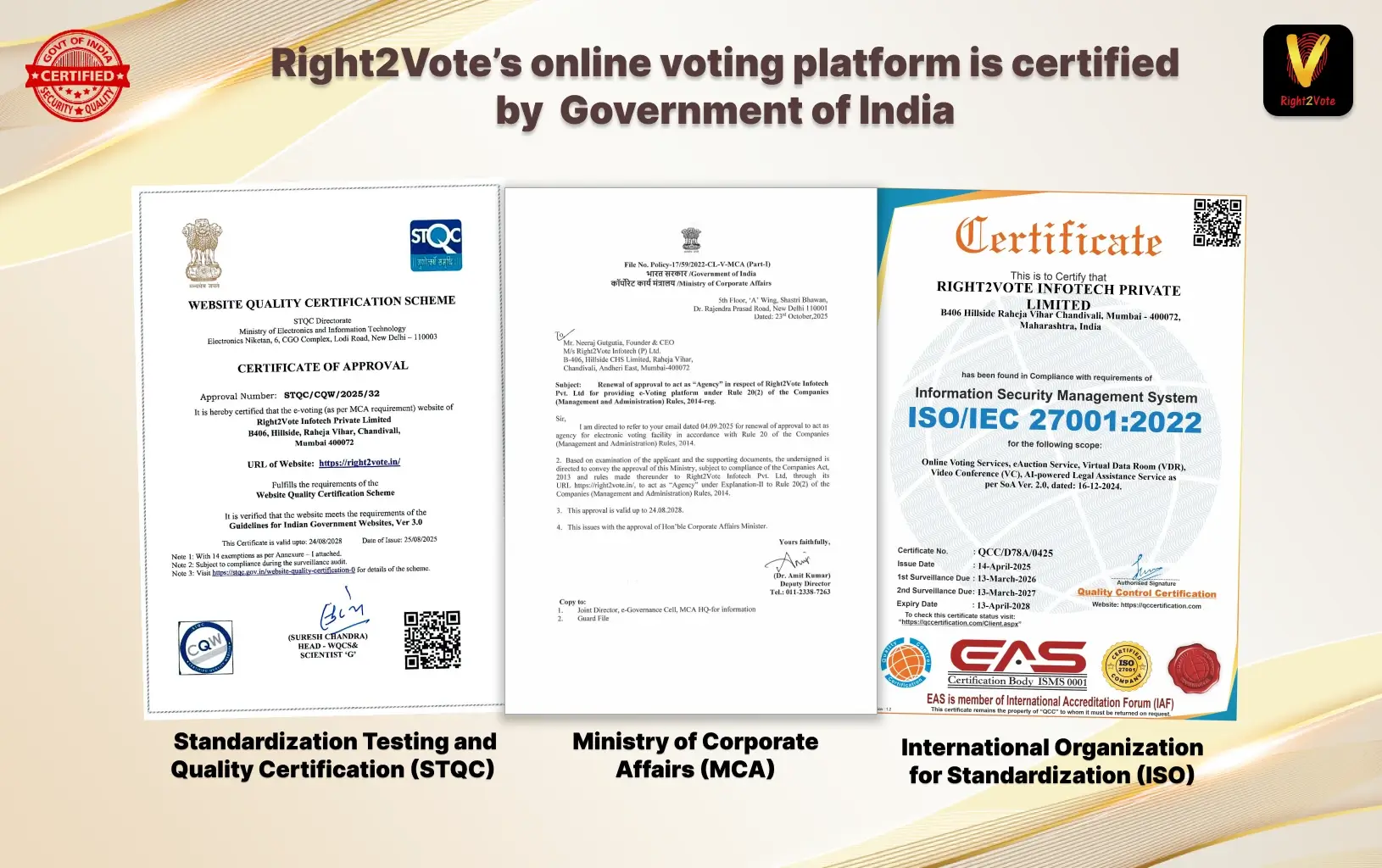
Certified by Government of India

Shareholder eVoting in India - Empowering Corporate Democracy

Every democratic nation conducts elections to ensure that citizens have the right to choose their representatives and leaders from national parliaments to village panchayats.

Book a demo Explore Features

543

Lok Sabha constituencies

5 years

Ordinary Lok Sabha term

Millions

Voters in a single election

OVERVIEW

Shareholder Voting and Online Shareholder eVoting

Shareholder voting is a fundamental part of corporate governance, giving shareholders the right to participate in a company’s key decision-making. Whether it is approving financial statements, electing directors, appointing auditors, approving mergers and acquisitions, or passing important corporate resolutions, shareholder voting allows investors to have a say in the future of the company.

Right2Vote provides digital voting technology that can help companies conduct shareholder eVoting in a simple, secure, and accessible manner. Shareholders can participate remotely using a mobile phone, tablet, or computer, depending on the voting process configured for the company. This is particularly useful for companies with shareholders located across different cities, states, or countries.

Electronic voting can reduce the dependence on physical ballots and make shareholder participation more convenient. It can also help companies manage voter authentication, resolutions, voting records, audit trails, and results through a structured digital process.

Shareholder eVoting as per Indian Law and Regulations

Electronic voting for shareholders in India is governed by the Companies Act, 2013, the Companies (Management and Administration) Rules, 2014, and, for listed entities, applicable SEBI regulations and circulars. Section 108 of the Companies Act and Rule 20 deal with voting through electronic means for prescribed classes of companies.

SEBI's Listing Obligations and Disclosure Requirements framework requires listed entities to provide a remote e-voting facility to shareholders in respect of shareholders' resolutions, subject to the applicable conditions.

Electronic voting has therefore become an important part of modern corporate governance in India. It enables eligible shareholders to participate in corporate decisions without necessarily being physically present at the meeting venue. Companies must, however, follow the applicable legal, regulatory, notice, record-date, voting-period, authentication, and result-declaration requirements.

Shareholder eVoting for AGMs, EGMs and Corporate Resolutions

Companies regularly require shareholder approval for important corporate decisions. Depending on the nature of the matter and applicable law, voting may be required at an AGM, EGM, or through postal ballot and electronic means.

Right2Vote's digital voting technology can be configured for different corporate voting requirements, allowing companies to create resolutions, manage eligible voters, authenticate participants, conduct voting, and generate voting reports.

For an AGM, shareholder voting may relate to matters such as financial statements, directors, auditors, remuneration, or other business included in the meeting notice. An EGM may involve specific corporate transactions or resolutions requiring shareholder approval.

The exact voting procedure, eligibility, voting entitlement, notice requirements, record date, voting period, and method of declaring results depend on the applicable law and the company's specific circumstances. A digital voting platform can support the technology and administration of the voting process while the company and its professional advisers remain responsible for statutory and regulatory compliance.

Right2Vote-Certified-eVoting-platform

Secure and Transparent Online Shareholder Voting

Security and confidentiality are critical when conducting shareholder voting because corporate resolutions can have significant financial and governance implications. An online shareholder voting platform should therefore provide appropriate authentication, access control, data protection, auditability, and voting safeguards.

Right2Vote provides features such as OTP-based authentication, secret ballot options, audit trails, voter management, and digital reports, depending on the voting configuration selected by the organization. These features can help create a structured and auditable voting process.

For shareholder voting, it is also important to ensure that only eligible shareholders or authorized participants are permitted to vote and that the voting entitlement is correctly configured. The voting process should maintain the confidentiality of a shareholder's voting choice wherever secret ballot requirements apply.

A secure eVoting process can help companies reduce manual intervention, improve administrative efficiency, and provide a clearer record of the voting process.

Shareholder Voting for Companies with Investors Across India and Abroad

Right2Vote-Certified-eVoting-platform

Modern companies can have thousands or even millions of shareholders located across different cities, states, and countries. International shareholders, NRIs, institutional investors, and individual investors may not be able to attend a physical AGM at the company's registered office or another meeting location.

Remote eVoting provides a convenient way for eligible shareholders to participate from their location, subject to the company's applicable voting procedure and legal requirements.

A digital shareholder voting system can help companies manage geographically distributed shareholders without requiring everyone to travel to the meeting venue. This can be particularly valuable for listed companies and other organizations with a large and diverse shareholder base.

SEBI's investor charter also recognizes eligible investors' right to cast votes on resolutions proposed by companies through internet-based e-voting facilities.

Global Adoption of Shareholder eVoting

Digital shareholder participation has become an important part of modern corporate governance in many markets. Companies and market infrastructures in different countries have adopted electronic systems to facilitate shareholder voting, meeting participation, and corporate resolutions.

The growth of electronic shareholder voting is driven by the increasing geographical spread of investors, the growth of digital securities ownership, and the need to make corporate participation more accessible.

India has also developed a structured electronic voting framework for eligible companies and listed entities. SEBI has issued specific requirements relating to remote e-voting for listed entities, while the Companies Act and associated rules provide the broader legal framework for electronic voting by prescribed classes of companies.

This transition toward digital shareholder participation demonstrates how technology can support corporate democracy while maintaining regulatory and governance requirements.

Right2Vote-Certified-eVoting-platform

Shareholder eVoting for Minority Shareholders

Shareholder participation is not limited to large institutional investors. Individual and minority shareholders also have an important role in corporate governance. However, smaller shareholders may find it difficult to travel to an AGM venue or participate in physical voting.

Remote eVoting can make participation more convenient by allowing eligible shareholders to vote without travelling to the company's meeting location. This can help create a more accessible voting environment for shareholders regardless of where they live.

Greater accessibility can support shareholder participation in resolutions and corporate decisions. For companies, a well-managed electronic voting process can also provide a structured method of recording votes and preparing results.

By reducing geographical barriers, shareholder eVoting can help strengthen the concept of corporate democracy and give eligible investors a more convenient way to exercise their voting rights.

Future of Shareholder Voting

The future of shareholder voting is increasingly digital. As companies and investors become more comfortable with online communication and digital financial services, electronic participation in corporate meetings and voting is becoming an important part of modern corporate governance.

Future shareholder voting systems are likely to focus on stronger authentication, better accessibility, improved auditability, automated voter entitlement management, and seamless participation across mobile and web platforms.

However, convenience cannot come at the cost of security or compliance. Shareholder eVoting must continue to maintain the principles of voter authentication, confidentiality, accuracy, transparency, auditability, and regulatory compliance.

For companies, adopting the right technology can make shareholder participation easier while reducing administrative complexity. For shareholders, digital voting can provide a convenient way to participate in important corporate decisions from wherever they are.

Right2Vote-Certified-eVoting-platform

Empower Your Shareholders with Digital Voting

Shareholder voting is an essential part of corporate governance, and technology can make the process more accessible, organized, and efficient. Right2Vote helps organizations conduct digital voting for AGMs, EGMs, resolutions, and other eligible corporate voting requirements.

With features such as secure authentication, secret ballot options, audit trails, digital voter management, and online accessibility, Right2Vote can help companies create a structured shareholder voting experience.

Whether your shareholders are located in Mumbai, Delhi, Bengaluru, Hyderabad, Chennai, Pune, Ahmedabad, Kolkata, another part of India, or overseas, digital voting can make participation more convenient, subject to applicable legal and regulatory requirements.

Choose a secure and reliable digital voting solution to simplify shareholder participation and strengthen corporate democracy.

Ready to Go Digital?

Join thousands of organizations that trust Right2Vote to conduct their elections securely and transparently.

FAQS

Frequently Asked Questions

What is shareholder voting?

Shareholder voting is the process through which eligible shareholders vote on resolutions and other matters proposed by a company. The voting rights attached to securities determine how a shareholder can vote.

What is shareholder eVoting?

Shareholder eVoting is the process of allowing eligible shareholders to cast their votes electronically instead of relying only on physical voting. It can be conducted through an internet-based voting platform according to applicable legal and regulatory requirements.

Is eVoting mandatory for companies in India?

The requirement depends on the class of company and the applicable law. Section 108 of the Companies Act, 2013 and Rule 20 of the Companies (Management and Administration) Rules, 2014 prescribe electronic voting requirements for specified classes of companies. Listed entities are also subject to applicable SEBI requirements.

Can shareholders vote online during an AGM?

Yes, where the applicable legal and meeting framework provides for electronic voting. Listed entities are required to provide remote e-voting for shareholders' resolutions subject to applicable conditions.

What is the difference between an AGM and an EGM?

An Annual General Meeting (AGM) is a regularly held shareholder meeting for annual and other applicable business. An Extraordinary General Meeting (EGM) is called to consider specific matters that require shareholder approval outside the ordinary AGM cycle.

Can shareholders vote from outside India?

Eligible shareholders may be able to participate remotely from outside India, depending on the company's voting process, applicable law, authentication requirements, and the voting facility being used.

How does shareholder voting work when shareholders own different numbers of shares?

Voting rights depend on the applicable class and terms of the securities and the governing legal and regulatory framework. Therefore, shareholder voting does not necessarily follow a simple one-person-one-vote model.

Is shareholder eVoting secure?

A secure shareholder eVoting system should use appropriate authentication, access controls, encryption and data protection measures, auditability, and safeguards for ballot confidentiality. The security of the overall process also depends on how the company configures and administers the election.

What resolutions can shareholders vote on?

Depending on the company and applicable law, shareholders may vote on matters such as financial statements, appointment or retirement of directors, auditors, mergers, acquisitions, changes to capital, amendments, and other ordinary or special resolutions.

Can Right2Vote conduct shareholder eVoting?

Right2Vote provides digital voting technology that can support shareholder voting, AGM voting, EGM voting, and corporate resolutions for eligible organizations. The company must ensure that the voting process and platform configuration comply with all applicable legal, regulatory, and governance requirements.


AJAX Loader
Contact us