Certified by Government of India

Student and College Voting

Every democratic nation conducts elections to ensure that citizens have the right to choose their representatives and leaders from national parliaments to village panchayats.

Book a demo Explore Features

543

Lok Sabha constituencies

5 years

Ordinary Lok Sabha term

Millions

Voters in a single election

OVERVIEW

Student and College Voting

Student elections are an important part of education because they introduce students to democracy, leadership, representation, and decision-making at an early stage of life. Schools, colleges, universities, and educational institutions use elections to select student representatives who can communicate students' interests and participate in institutional activities. Student elections can also help students understand how democratic processes work in practice.

India has a large education ecosystem comprising schools, colleges, universities, and other educational institutions. Depending on the institution, elections may be conducted for class representatives, head boy or head girl, student councils, college unions, department representatives, hostel committees, sports teams, societies, and alumni associations.

Some institutions conduct small internal elections, while others conduct large and highly competitive student elections. Online student voting can make these elections easier to organize by allowing eligible students to vote through mobile phones, tablets, or computers. Right2Vote provides digital voting technology that can help educational institutions conduct secure and convenient elections while reducing queues, paperwork, manual counting, and administrative effort.


Class Representative and Class Monitor Elections

  • Class monitor and class representative elections are among the earliest forms of democratic participation for students. In some schools, teachers nominate class monitors, while in others, students are allowed to select their representatives through voting.
  • The elected class representative can act as a communication link between students and teachers and may help coordinate class activities, events, academic discussions, and other student requirements. In colleges, class representatives can also represent students in department or college-level meetings.
  • Online voting can make class representative elections quick and convenient. Students can vote using their mobile phones or computers without requiring a separate polling booth. The institution can define the eligible voters, candidates, voting period, and voting rules before the election begins.
  • For larger institutions with many classes and sections, a digital voting platform can help manage multiple elections systematically. This reduces the administrative work involved in preparing paper ballots and manually counting votes.

Head Boy, Head Girl and Student Council Elections

  • Many schools conduct elections for positions such as Head Boy, Head Girl, School Captain, Vice Captain, and other student council positions. These elections provide students with an opportunity to choose leaders who represent them and participate in school activities.
  • Some schools also have student parliaments or student councils with multiple elected positions. Students may vote for representatives from different classes or sections, depending on the school's election structure.
  • Conducting these elections digitally can make the voting process faster and more accessible. Students can vote from classrooms or other authorized locations without creating long queues at polling booths.
  • Right2Vote can help educational institutions configure candidates, eligible voters, voting positions, and election schedules according to their requirements. Secure authentication can help ensure that only eligible students participate and that each student can vote according to the defined election rules.

Sports Team and Captain Elections

  • Schools and colleges generally have multiple sports teams and activity groups. These may include cricket, football, basketball, athletics, badminton, tennis, cultural teams, debate teams, and other student activities.
  • Depending on institutional rules, team captains or leaders may be selected by teachers, coaches, or team members through voting. When students are allowed to elect their captain, the voting process provides another opportunity to practice leadership and democratic decision-making.
  • Online voting can make these elections simple and quick. Eligible team members can vote electronically without requiring a separate physical voting arrangement. The institution can conduct different elections for different teams and restrict voting to the relevant team members.
  • This makes eVoting particularly useful for institutions with multiple sports teams, societies, and student activity groups that conduct elections throughout the academic year.

Parents and Teachers Association (PTA) Elections

  • Parents and Teachers Associations play an important role in creating structured communication between parents, teachers, and the school administration. In many institutions, parent representatives are selected through a voting or election process.
  • PTA elections may take place at the class level as well as at the school or institution level. Depending on the rules of the institution, representatives may be elected for a defined tenure and new representatives may be selected periodically.
  • Online voting can make PTA elections more convenient for eligible parents who may not be able to visit the school specifically to cast their vote. Parents can participate remotely through a secure digital voting process, subject to the institution's rules.
  • A digital platform can help manage eligible parent voters, voting positions, authentication, voting periods, and results. This can reduce paperwork and administrative effort for teachers and school administrators while making participation easier for parents.

College Student Elections

  • College elections can involve a larger and more diverse student population. Many colleges have student bodies with positions such as President, Vice President, General Secretary, Treasurer, and other elected representatives.
  • Students may also elect representatives responsible for specific areas such as academics, sports, infrastructure, cultural activities, media, technology, student welfare, or annual festivals.
  • The elected student body may represent students in discussions with college management and help organize student activities and events. College elections can therefore play an important role in developing leadership, communication, organizational, and decision-making skills.
  • Online college voting can simplify the election process by allowing eligible students to vote remotely. It can eliminate the need for large physical queues and reduce the time teachers and students need to spend managing polling booths and manual counting.

Department and Faculty Elections

  • Large colleges and universities often have separate academic departments with their own student representatives or departmental committees. Department elections are generally restricted to students belonging to the relevant department.
  • For example, students from the engineering department may elect their departmental representatives separately from students in commerce, management, law, medicine, arts, or other departments.
  • A digital voting platform can make such elections easier by creating separate voter groups and restricting each election to the appropriate students. Multiple department elections can also be conducted using a centralized election management process.
  • This can be particularly useful for universities and large colleges where hundreds or thousands of students participate in elections across multiple departments and courses.

Society, Club and Interest Group Elections

  • Schools and colleges have numerous student societies and interest groups. These can include debating societies, drama clubs, music clubs, sports societies, entrepreneurship clubs, finance clubs, marketing clubs, media groups, technology clubs, writers' clubs, and cultural organizations.
  • These societies often have their own leadership teams and management committees. Depending on the institution's rules, members may elect positions such as President, Secretary, Treasurer, Event Coordinator, or other committee members.
  • Online voting can help these societies conduct elections among their members without requiring a separate polling booth. The voter list can be restricted to eligible members of the particular society, ensuring that only authorized students participate.
  • For institutions with many societies, digital voting can also provide a consistent election process while allowing each group to customize its candidates, positions, voting period, and eligibility rules.

Hostel Elections and Student Representation

  • Hostel life is an important part of student life in many schools, colleges, and universities. Students living in hostels may elect representatives to manage or communicate matters related to hostel activities and student requirements.
  • Hostel elections can include positions such as President, Vice President, Secretary, Treasurer, Mess Representative, Sports Representative, Cultural Representative, Infrastructure Representative, and other roles.
  • Since hostel elections are often restricted to students living in a particular hostel or residence, the voting system needs to ensure that only eligible residents can participate.
  • Online voting can make hostel elections easier by allowing students to vote from their rooms or other authorized locations. It eliminates the need for students to stand in queues at a physical polling location and can help election committees manage multiple hostel elections efficiently.

Teacher and Faculty Association Elections

  • Educational institutions may also have teacher or faculty associations that conduct elections for their office bearers and managing committees. These elections are separate from student elections and generally involve eligible teaching or academic staff.
  • Positions may include President, Vice President, Secretary, Treasurer, and other committee members. The elected representatives may communicate the interests of faculty members to the institution's management or represent them in relevant discussions.
  • Online voting can provide a convenient way for eligible faculty members to participate, particularly in universities where teachers may be spread across multiple departments, campuses, or locations.
  • A digital voting platform can help manage the eligible voter list, authentication, election positions, voting period, and result calculation while reducing manual election administration.

University-Level Student Elections

  • In addition to college-level elections, some universities conduct elections at the university level. These elections may involve students from multiple colleges, departments, faculties, or campuses.
  • University-level student representatives can communicate student concerns to university authorities and participate in discussions concerning student welfare, academic matters, campus facilities, activities, and other institutional issues.
  • Because university elections can involve a large number of students distributed across multiple locations, organizing physical voting can require substantial infrastructure and manpower.
  • Where permitted by the institution's rules and applicable requirements, online voting can provide a centralized way for eligible students to participate. Students can vote remotely while the institution manages the election through a structured digital process.

Alumni Association Elections

  • Schools, colleges, and universities often have large alumni communities spread across different cities and countries. Alumni associations help institutions maintain relationships with former students and can support networking, mentoring, placements, fundraising, events, and institutional development.
  • Many alumni associations have elected office bearers and managing committees. Positions may include President, Vice President, Secretary, Treasurer, and other committee members.
  • Physical elections can be difficult when alumni live across India or overseas. Online alumni voting allows eligible members to participate without travelling to the institution or election venue.
  • Right2Vote can support digital elections for alumni associations by helping manage eligible voters, authenticate members, conduct voting, and generate results. This can make alumni elections more accessible and help increase participation among geographically distributed alumni.

Why Online Voting is Useful for Student Elections

Traditional student elections can require polling booths, printed ballots, queues, volunteers, election officers, security arrangements, and manual vote counting. These activities can take significant time and may interfere with regular academic activities.

Online student voting can simplify the process. Students can vote through their mobile phones, tablets, or computers, depending on the institution's election rules and configuration.

For schools, colleges, universities, and educational institutions, eVoting can provide a modern approach to conducting student elections and representative selection.

Key benefits include:

No physical polling booth or long queues
Convenient voting through mobile or computer
Potentially higher voter participation
Digital audit trails
Faster result calculation
Less disruption to classes
Reduced paperwork and manual counting
Secure voter authentication
Easier management of multiple elections
Reduced administrative effort and cost

Secure and Transparent Student eVoting with Right2Vote

Right2Vote provides digital voting technology for eligible educational institutions and organizations. The platform can be configured for different types of student, faculty, and alumni elections according to the institution's requirements.

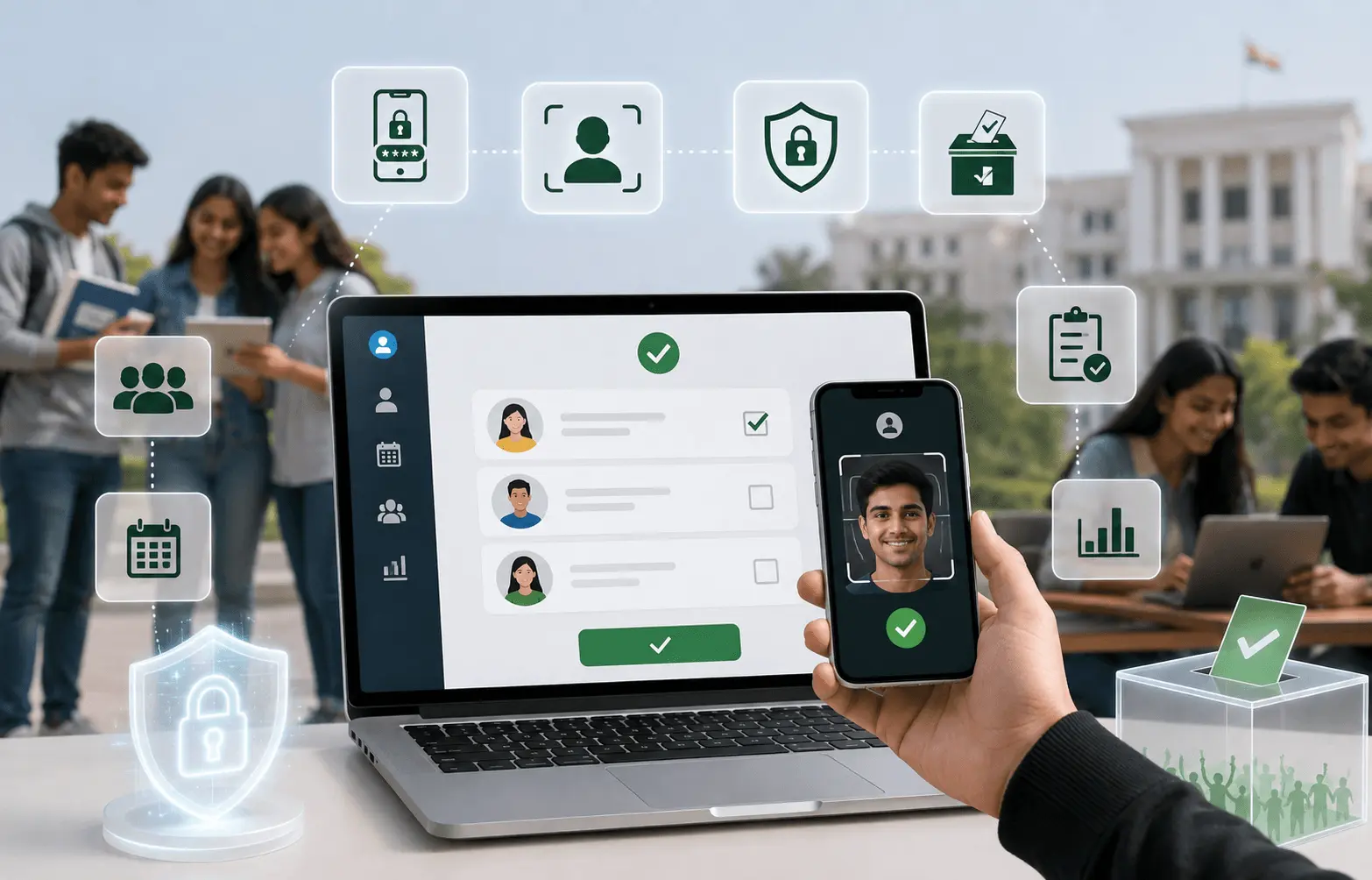
Depending on the selected configuration, security and election-management features can include OTP authentication, voter selfie, face recognition, secret ballot, audit trails, voter management, election scheduling, and digital result reporting.

Secret ballot voting can help protect the privacy of a student's voting choice where required. Audit trails can provide records of relevant voting activities, helping the institution maintain a structured and auditable election process.

The platform can also reduce manual intervention in voter management, vote recording, and result calculation. This can save teachers, administrators, and student election committees significant time and effort.

Right2Vote-Certified-eVoting-platform

Future of Student and College Elections

Right2Vote-Certified-eVoting-platform

Student elections are more than just a method of selecting representatives. They provide students with practical experience of democracy, leadership, participation, accountability, and collective decision-making.

As educational institutions increasingly adopt digital technology, online voting can become an important tool for conducting student, faculty, department, society, hostel, university, and alumni elections.

Digital voting can make elections more convenient for students while reducing the administrative burden on educational institutions. It can also allow institutions to conduct elections without unnecessarily disrupting regular classes and academic activities.

The use of online voting should always follow the institution's election rules, applicable regulations, and requirements. Where permitted, a secure digital voting platform can help educational institutions conduct efficient, transparent, and accessible elections.

Conduct Your Student Election with Right2Vote

Whether an institution needs to conduct a class representative election, student council election, college election, department election, hostel election, faculty election, society election, university election, or alumni association election, Right2Vote can provide a digital voting solution.

The platform can help institutions manage eligible voters, configure candidates and positions, authenticate voters, conduct secure voting, maintain audit trails, and generate election results.

Students can participate through their mobile phones or computers, reducing the need for physical polling booths and queues. This can save time for both students and election administrators while helping make participation more convenient.

Right2Vote helps educational institutions bring student elections into the digital age with secure, convenient, and structured online voting technology.

EASE OF USE

Right2Vote's eVoting platform and students' elections

Right2Vote's mobile voting platform provides a very cost efficient, secure and user-friendly solutions to all election needs of an educational institute. Key benefits of Right2Vote's eVoting platform over booth-based paper voting are:

01

No booth and no queue

Students can vote directly from their mobile phones. They need not waste time standing in a queue.

02

Higher voter turnout

Students can vote from anywhere and anytime. They do not have to waste time standing in a queue or travelling to the booth. Thus, voter turnout is much higher.

03

No missed classes and no election holiday

School and college is able continue with regular teaching activity on election day, as activity of voting does not take more than a minute for each student. Each student can vote sitting in their classrooms directly from their mobile phones or laptops.

04

Secure

Each voter is authenticated using One Time Password (OTP) and can vote only once. Voting data is protected by encryption. There is no chance of any kind of malpractices.

05

Transparent

The whole voting process is very transparent. Audit trail feature provides IP address and time of voting of each voter. Each voter gets a record of his vote on his email.

06

Instant results

Right2Vote's online voting platform provides instant result as soon as the voting is over. The result is auto computed by the system and there is no manual intervention. Hence there is no chance of any human error.

07

Efficient

Right2Vote's eVoting service is totally automated and does not require any booths for voter verification, vote registration, counting etc. The whole process is automatic and free of human intervention. This saves lot of time and effort on part of election management committee including teachers and students. The institute saves time, cost, and human effort with Right2Vote's election platform.

08

Cost effective

eVoting on Right2Vote is very cost effective. The cost of holding an online voting event is a fraction of the cost of holding a physical voting event. To know more about the pricing of eVoting service, click here

Ready to Go Digital?

Join thousands of organizations that trust Right2Vote to conduct their elections securely and transparently.

FAQS

Frequently Asked Questions

What is student voting?

Student voting is the process through which students elect representatives, leaders, committee members, or student body office bearers in schools, colleges, universities, and other educational institutions.

What types of student elections can be conducted online?

Online voting can be used for eligible elections such as class representative elections, student council elections, college elections, department elections, hostel elections, society elections, sports captain elections, university elections, and alumni elections.

Can schools conduct Head Boy and Head Girl elections online?

Yes. Schools can conduct Head Boy, Head Girl, School Captain, Vice Captain, and student council elections through an online voting platform where permitted by their election rules.

Can students vote using their mobile phones?

Yes. An online voting platform can allow eligible students to vote using mobile phones, tablets, or computers, depending on the institution's voting configuration.

Can online voting reduce disruption to classes?

Yes. Students can vote digitally without necessarily visiting a polling booth or standing in a queue. This can help institutions conduct elections with less disruption to regular academic activities.

Can online voting increase student voter turnout?

Online voting can make participation more convenient because students do not necessarily need to travel to a polling location or wait in a physical queue. This may help improve voter participation.

Can colleges conduct separate elections for different departments?

Yes. A digital voting system can be configured with separate voter groups so that students are allowed to vote only in elections for which they are eligible.

Is online student voting secure?

A properly configured voting platform can use security measures such as OTP authentication, access controls, secret ballot options, audit trails, and other security features. The appropriate configuration depends on the institution's election requirements.

Can alumni associations conduct elections online?

Yes. Alumni associations can conduct eligible elections online, which can be particularly useful when alumni are distributed across different cities or countries.

Can Right2Vote conduct student and college elections?

Yes. Right2Vote provides digital voting technology for eligible schools, colleges, universities, student societies, faculty associations, and alumni associations. The platform can be configured according to the institution's election structure and applicable requirements.


AJAX Loader
Contact us