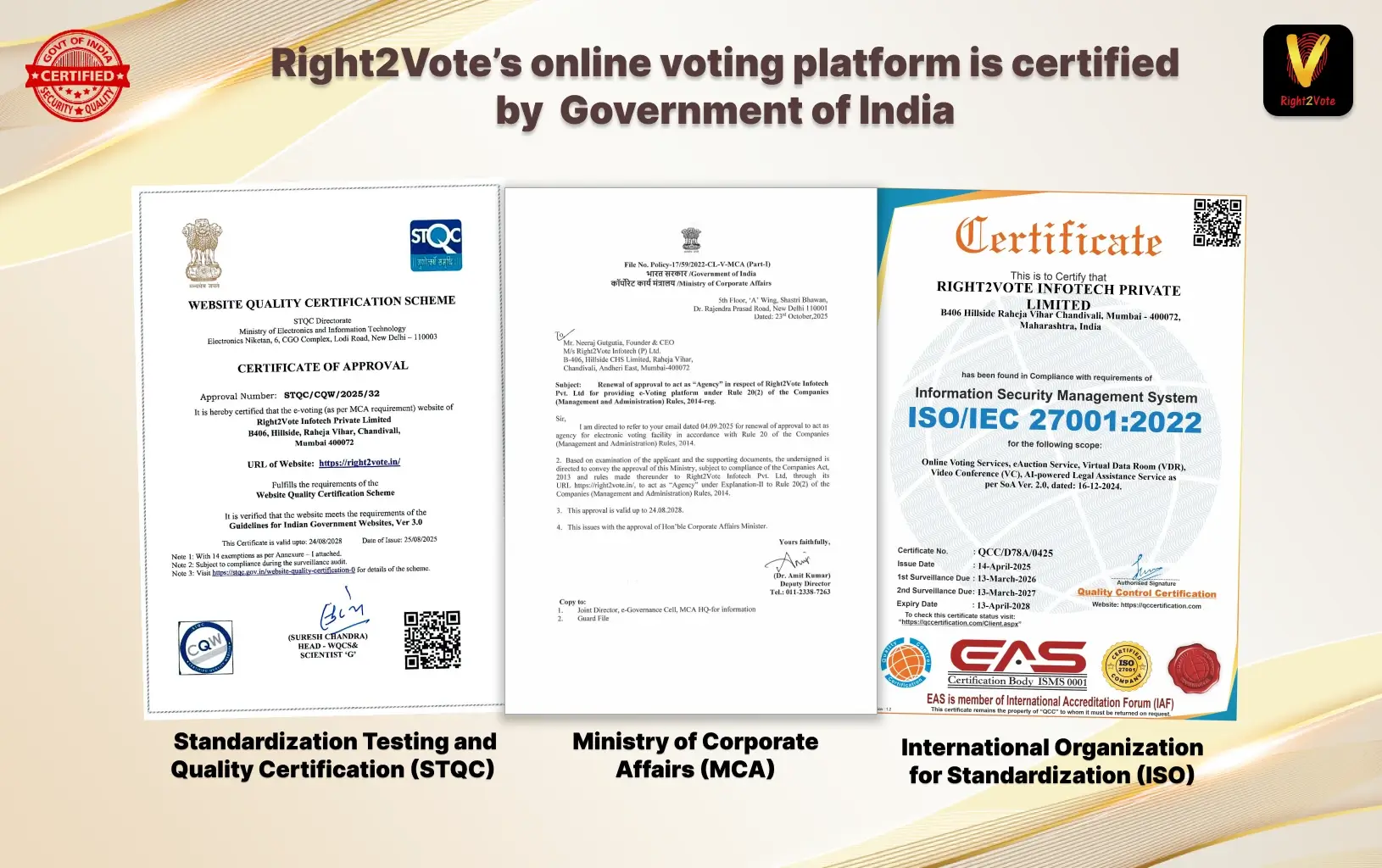
Certified by Government of India

Political Voting and Online Voting in Elections

Every democratic nation conducts elections to ensure that citizens have the right to choose their representatives and leaders from national parliaments to village panchayats.

Book a demo Explore Features

543

Lok Sabha constituencies

5 years

Ordinary Lok Sabha term

Millions

Voters in a single election

eVoting-for-IRPs-under-ibc - Right2vote
OVERVIEW

Political Voting and Online Voting in Elections

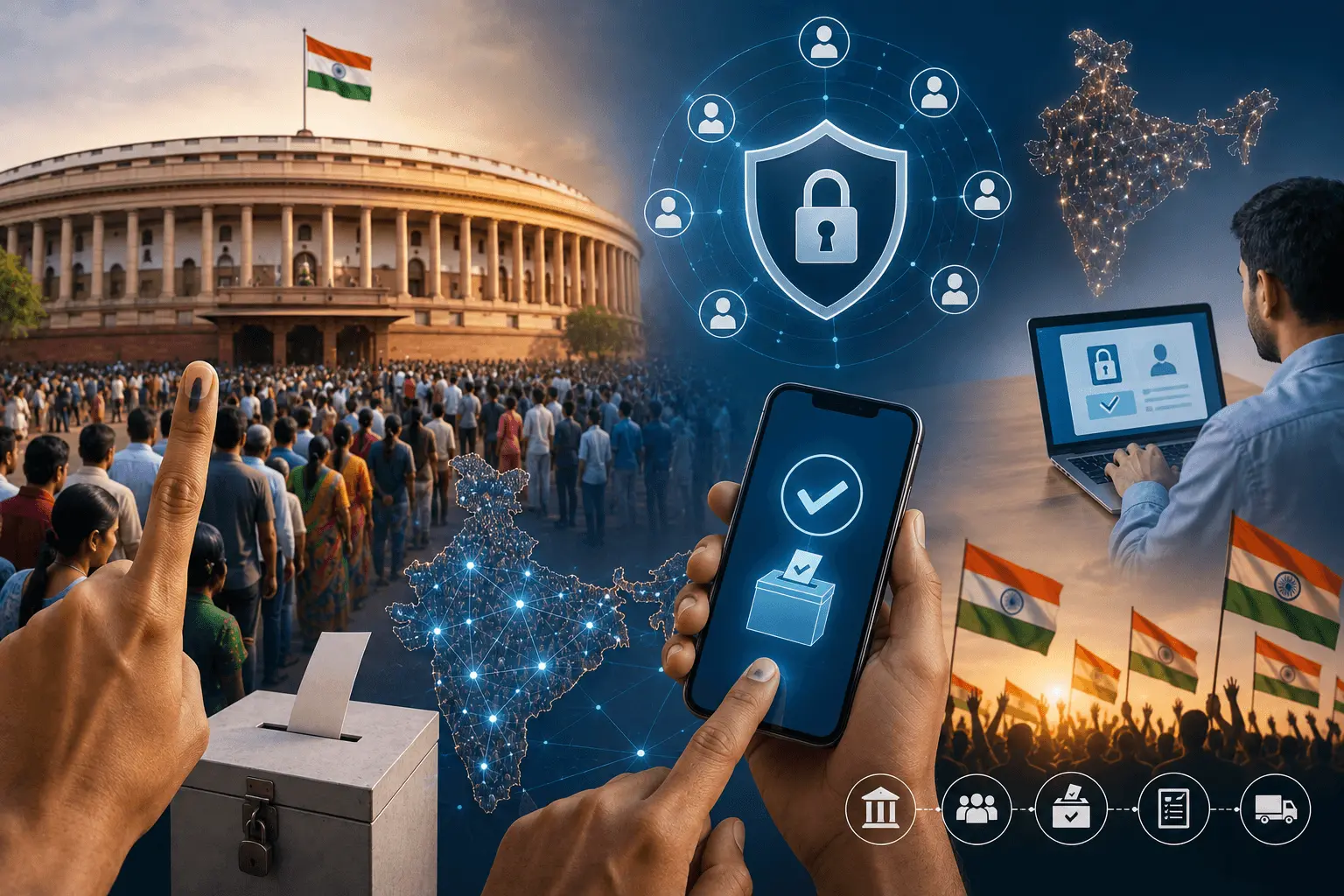
Every democratic nation conducts elections to ensure that citizens have the right to choose their representatives and leaders. Political voting is one of the most important parts of a democratic system because it gives citizens a direct way to participate in government and public decision-making. Elections can take place at the national, state and local levels, depending on the country's political and administrative structure.

In India, the national election, or Lok Sabha election, is generally conducted every five years. The Lok Sabha has 543 elected constituencies, where Members of Parliament (MPs) are directly elected by citizens through voting. The elected representatives then participate in the process of forming the central government, with the leader of the majority becoming the Prime Minister of India.

Political voting is not limited to national elections. Countries regularly conduct state, provincial, municipal and local elections to elect representatives at different levels of government. Political voting therefore involves millions of voters, thousands of constituencies, large election teams, extensive logistics and significant public expenditure.

State Elections and Voting for Members of Legislative Assemblies

  • In India, political voting also takes place at the state level. Citizens vote in state legislative elections to elect their representatives, known as Members of the Legislative Assembly (MLAs). The elected MLAs form the state legislative assembly and participate in selecting the government and its leadership. The leader who commands the required majority becomes the Chief Minister of the state.
  • State elections are conducted according to the constitutional and electoral framework applicable to each state. The election process involves voter registration, electoral rolls, candidate nominations, campaigning, polling, counting, and declaration of results. Because India has multiple states and union territories with different political and administrative structures, elections take place across the country at different times.
  • Political voting at the state level is important because state governments are responsible for several areas that directly affect citizens, including public health, education, transport, agriculture, infrastructure, law and order, and other state-level services. State elections therefore allow citizens to choose representatives who will participate in making decisions that affect their daily lives.

Municipal, Panchayat and Local Body Elections in India

  • Political voting in India also includes elections to local government institutions. Local body elections allow citizens to elect representatives responsible for governance closer to their communities. Depending on the location and type of local body, elections may include Municipal Corporations, Municipal Councils, Nagar Panchayats, and Panchayati Raj institutions such as Gram Panchayats.
  • Urban local bodies manage several civic responsibilities, including roads, sanitation, waste management, local infrastructure, public facilities, and other municipal services. Rural local bodies play an important role in village-level development and administration. The names, structure, powers, and election arrangements can vary between states.
  • Local elections can involve a very large number of candidates, voters, wards, constituencies, and polling locations. This makes election management a complex administrative exercise. Secure digital technologies and online voting systems can potentially support specific organizational or electoral processes where permitted by the applicable election laws, regulations, and authorities.

Indirect Elections in the Indian Political System

  • Not every political election in India is conducted through direct voting by all citizens. India also has several important indirect elections in which elected representatives or members of an electoral college participate in choosing representatives or constitutional office holders.
  • The Rajya Sabha, the upper house of Parliament, includes members elected through an indirect election process by elected members of State Legislative Assemblies, along with nominated members as provided under the Constitution. Some Indian states also have Legislative Councils, known as Vidhan Parishads, where members are elected through different electoral categories.
  • The elections for the President and Vice-President of India are also indirect elections. These elections use an electoral college and a voting system based on proportional representation through the Single Transferable Vote (STV), along with a system of vote value. Because these elections have different eligibility, electoral-college, and counting rules, their voting and counting processes are significantly different from ordinary direct elections.

The Cost and Complexity of Conducting Elections

Conducting elections at a national, state, or local level requires substantial planning, manpower, infrastructure, security arrangements, transportation, election materials, technology, polling facilities, voter information systems, and counting infrastructure. Large-scale elections can therefore involve significant public expenditure.

India's elections are among the world's largest democratic exercises, involving hundreds of millions of voters and extensive administrative arrangements. Election authorities must ensure that eligible voters can participate while maintaining the integrity, secrecy, security, and transparency of the electoral process.

Technology has increasingly become an important part of election administration. Electronic voting machines, voter-verifiable paper audit trails, digital voter services, election management systems, and other technologies are used in different parts of the electoral process. Any introduction of internet or mobile voting for public elections must comply with the applicable constitutional, statutory, regulatory, cybersecurity, and election-authority requirements.

Can Online Voting Change the Future of Political Elections?

Online voting, also known as internet voting or remote electronic voting, allows eligible voters to cast their vote through a digital device instead of visiting a traditional polling station. Around the world, governments and election authorities have explored different forms of electronic and internet voting, particularly for specific voter groups and controlled electoral environments.

A potential advantage of online voting is accessibility. Voters who are away from their constituency, living in another city or country, or facing difficulties reaching a polling station may find remote voting more convenient. However, political elections require extremely high levels of security, voter authentication, ballot secrecy, transparency, auditability, and public trust.

For this reason, online political voting cannot simply replace traditional elections without appropriate legal authorization, independent testing, security controls, and approval from the competent election authorities. Technology providers can develop secure voting infrastructure, but the use of such technology in public elections must always follow the laws and rules established by the relevant election authority.

Right2Vote-Certified-eVoting-platform

Secure Digital Voting Technology for Political and Organizational Elections

Right2Vote-Certified-eVoting-platform

Right2Vote provides digital voting technology designed for organizations and controlled electoral environments.Right2Vote is tested and certified by STQC, MCA, ISO 27001 and CERT-IN security agency. Its technology can support different voting requirements through features such as voter authentication, OTP verification, secret ballot, audit trails, voter selfie, face recognition, and other security controls depending on the election configuration.

Digital voting can be particularly useful for organizations, associations, institutions, and other eligible bodies that need to conduct elections or voting remotely. It can help reduce manual processes, simplify voter management, provide convenient access to voters, and generate structured voting records.

Any future adoption of online political voting would require appropriate legal, regulatory, technical, and security approvals. The goal of secure voting technology is to make participation convenient while protecting the fundamental principles of election integrity, voter privacy, transparency, and accountability.

Ready to Go Digital?

Join thousands of organizations that trust Right2Vote to conduct their elections securely and transparently.

FAQS

Frequently Asked Questions

What is political voting?

Political voting is the process through which eligible citizens or members of an electoral college vote to choose political representatives or decide between candidates in an election.

What are the different types of political elections in India?

Political elections in India include Lok Sabha elections, State Assembly elections, local body elections, Rajya Sabha elections, Legislative Council elections in applicable states, and elections for constitutional offices such as the President and Vice-President.

How often are Lok Sabha elections held in India?

The Lok Sabha normally has a five-year term, so general elections are ordinarily held every five years unless the Lok Sabha is dissolved earlier.

What is the difference between direct and indirect elections?

In a direct election, eligible voters directly vote for candidates. In an indirect election, members of an electoral college or elected representatives vote to elect the representative or office holder.

What are local body elections?

Local body elections are elections held to choose representatives for local government institutions such as Municipal Corporations, Municipal Councils, Nagar Panchayats, and Panchayati Raj institutions.

What is online political voting?

Online political voting, or internet voting, refers to casting an election vote electronically through an internet-connected device. Its use in public elections depends on applicable laws, regulations, and approval from the competent election authority.

Is online voting secure?

The security of online voting depends on the technology, authentication methods, cybersecurity controls, ballot secrecy, auditability, independent testing, and election procedures used. Public elections require particularly stringent security and regulatory standards.

Can political elections be conducted through mobile phones?

Mobile voting technology can technically enable voting through smartphones, but whether it can legally be used for a particular political election depends on the applicable election laws and the decision of the competent election authority.

What is secret ballot voting?

Secret ballot voting is a voting method designed to protect the privacy of a voter's choice. It prevents other people from knowing which candidate or option an individual voter selected.

Can Right2Vote conduct government political elections?

Right2Vote provides digital voting technology for eligible organizations and controlled elections. The use of any online voting platform for government or public political elections would require authorization and compliance with the applicable laws, regulations, and requirements of the relevant election authorities.


AJAX Loader
Contact us