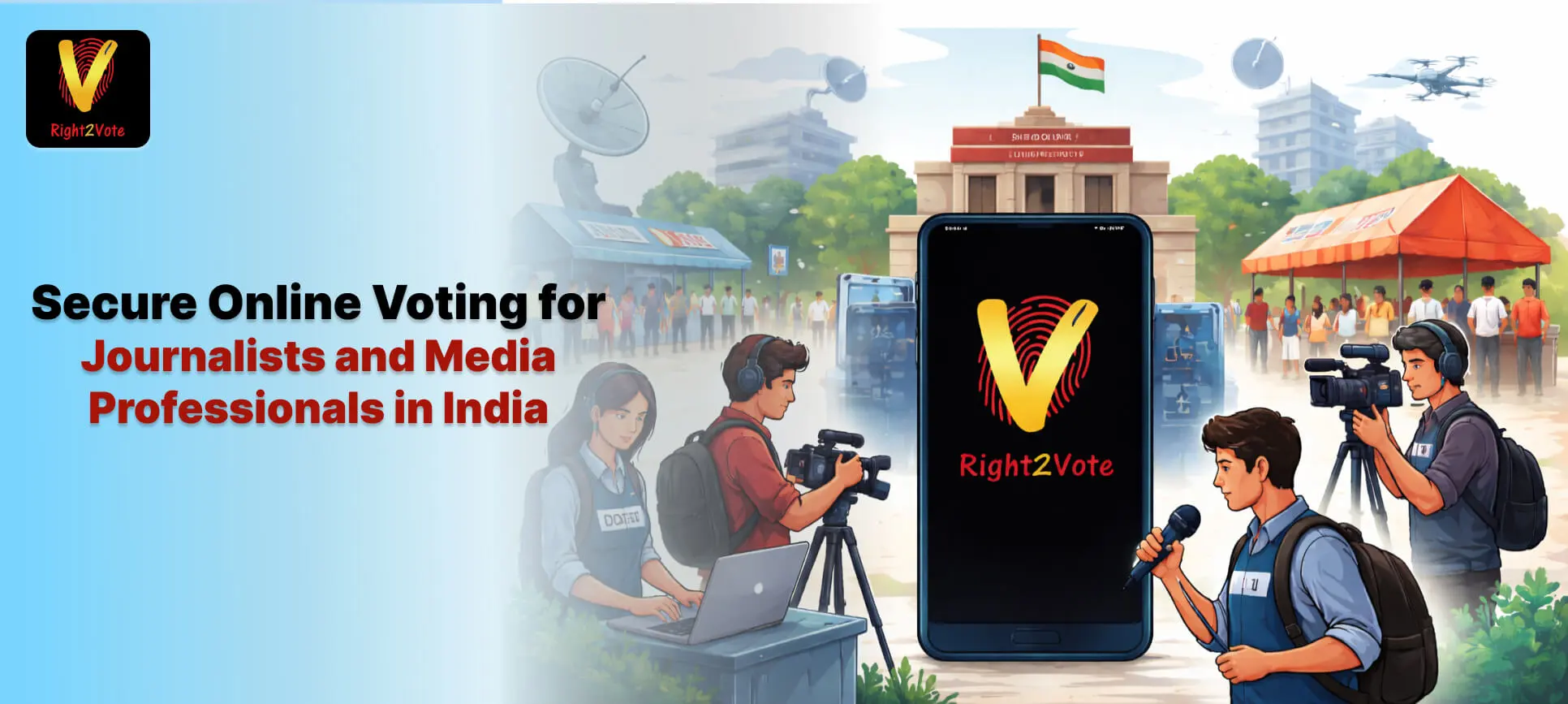
Secure Online Voting for Journalists and Media Professionals in India
Journalists and media professionals play a vital role in strengthening democracy. They report from the ground, bring transparency to elections, and ensure that citizens are informed. From political rallies to polling booths, their presence is constant especially during major events like the Indian General Elections conducted by the Election Commission of India.
However, there is a hidden irony. While journalists are responsible for covering elections and encouraging citizens to vote, many of them are unable to cast their own vote. Their profession demands mobility, urgency, and unpredictable working hours. On election day, they are often deployed far away from their registered polling booth, reporting live updates rather than participating in the process themselves.
This challenge extends beyond national elections. Journalists are also part of press clubs, media associations, unions, and editorial boards where elections are conducted to choose leadership and make key decisions. Unfortunately, participation in these elections is often low due to the same reasons tight schedules, field assignments, and location constraints.
This creates a gap between awareness and participation. The voices of journalists who are essential stakeholders in democracy often go unheard in their own professional ecosystem. Secure online voting is a powerful solution that bridges this gap, ensuring that no media professional is left out of the democratic process.
Key Challenges Journalists Face in Traditional Voting Systems
The profession of journalism is fast-paced and highly demanding. Unlike many other careers, it does not operate within fixed hours or locations. This creates several barriers when it comes to participating in traditional booth-based voting systems.
- Field Assignments During Elections
During elections, journalists are often assigned to cover constituencies, sometimes in entirely different states. For example, a reporter based in Delhi might be sent to Uttar Pradesh or West Bengal for coverage. On voting day, they are busy reporting from polling booths, interacting with voters, and delivering live updates. Traveling back to their registered constituency to vote is simply not possible.
- Unpredictable Working Hours
News does not follow a schedule. Breaking stories can happen at any time early morning, late night, or even continuously for hours. Journalists often work extended shifts, making it difficult to plan a visit to a polling booth within fixed voting hours.
- Location and Mobility Constraints
Media professionals are constantly on the move. A journalist might be in one city today and another tomorrow. This mobility creates a mismatch between their current location and their registered voting location, making physical voting inconvenient.
- Deadline Pressure and Live Reporting
During critical events like elections, journalists operate under strict deadlines. Missing a live broadcast or failing to report a key development is not an option. As a result, voting often becomes a lower priority.
- Urban Challenges and Time Limitations
Even when journalists are in their home city, factors like traffic, long distances, and time constraints can prevent them from reaching polling booths on time.
- Low Participation in Organizational Elections
Press clubs, journalist unions, and media organizations often conduct elections through physical booths. Journalists who are traveling or working during these times are unable to participate, leading to lower voter turnout.
Example: A field reporter covering election day in a rural constituency may spend 12–14 hours on the ground, reporting continuously. Despite being deeply involved in the election process, they may not get a chance to vote themselves.
The Impact of Low Participation in Media Elections
When journalists are unable to participate in elections both public and organizational, it creates several long-term issues:
- Leadership in media bodies may not reflect the entire community
- Important decisions may lack diverse perspectives
- Young and field-based journalists remain underrepresented
- Engagement within associations decreases over time
For instance, if only a small percentage of members vote in a press club election, the results may not truly represent the collective voice of the media community. This can affect policy decisions, governance, and the overall direction of the organization.
In a profession that thrives on representation and voice, this lack of participation is a serious concern.
How Secure Online Voting Solves These Challenges
Online voting is designed to eliminate the barriers created by time, distance, and workload. It empowers journalists to participate in elections without disrupting their professional responsibilities.
- Vote from Anywhere, Anytime
Journalists can cast their vote from any location, whether they are in a newsroom, on assignment, or traveling. All they need is a smartphone or laptop with internet access.
- Flexible Voting Window
Unlike traditional voting that is limited to a few hours, online voting allows extended time windows (24–48 hours or more). This flexibility ensures that journalists can vote at their convenience.
- No Travel or Physical Presence Required
There is no need to visit a polling booth. This saves time and removes logistical challenges, especially for those working in remote locations.
- Quick and User-Friendly Process
Voting can be completed within minutes. The process is simple, guided, and designed for ease of use, even for those who are not highly tech-savvy.
- Secure and Confidential System
Modern eVoting platforms use encryption, secure login methods, and authentication processes to ensure that votes remain private and tamper-proof.
- Increased Participation and Fair Representation
When voting becomes easy and accessible, more journalists participate. This leads to better representation and stronger democratic outcomes within organizations.
Example: A journalist covering a breaking political story in another state can take a short break, log into the voting platform, and cast their vote within minutes, something that would be impossible with traditional voting.
Right2Vote eVoting Solution for Media Professionals
Right2Vote offers a secure and efficient eVoting platform tailored for organizations, including media houses, press clubs, and journalist associations. The platform is designed to ensure that no journalist is denied their right to vote due to professional constraints.
Key Features of Right2Vote for Media Elections
- Advanced Security Measures
Right2Vote uses strong encryption, OTP-based authentication, and secure voter verification to ensure that only authorized individuals can vote. This prevents fraud and ensures the integrity of the election.
- Simple and Intuitive Interface
The platform is designed with simplicity in mind. Journalists can log in and vote within minutes without needing technical expertise.
- Mobile-Optimized Experience
Understanding that journalists are always on the move, the platform works seamlessly on mobile devices, enabling voting from anywhere.
- Real-Time Monitoring and Transparency
Election administrators can track participation and monitor the process in real time, ensuring complete transparency.
- Instant and Accurate Results
Votes are counted automatically, eliminating manual errors and delays. Results can be declared quickly and efficiently.
- Scalable for All Organization Sizes
Whether it is a small press club or a large national media association, the platform can handle elections of any scale.
Hybrid Voting: Combining Online and Booth-Based Systems
Right2Vote also offers a hybrid voting model, which combines the benefits of online and traditional voting.
This approach ensures inclusivity:
- Journalists on assignment can vote online
- Members available locally can vote at physical booths
- Both methods are integrated into a single secure system
This is particularly useful in India, where digital adoption levels may vary across different regions and age groups.
The Future of Voting for Journalists in India
India is rapidly moving toward digital transformation across industries, including media. With the rise of digital journalism, remote reporting, and mobile newsrooms, the need for flexible and accessible systems is greater than ever.
While public elections under the Election Commission of India are still exploring remote voting options, organizational elections can already benefit from secure online voting platforms like Right2Vote.
In the coming years, we can expect:
- Wider adoption of eVoting in press clubs and media bodies
- Higher participation from field journalists
- More transparent and efficient election processes
- Stronger representation of diverse voices within the media industry
Ensuring Every Journalist's Voice is Heard
Journalists dedicate their careers to amplifying the voices of others. They highlight issues, question systems, and inform the public. It is equally important that their own voices are heard in decisions that affect their profession.
Whether it is a national event like the Indian General Elections or a local press association election, participation should not be limited by professional constraints.
Right2Vote ensures that journalists can vote without compromising their responsibilities.
Empowering Media Through Technology
In a democracy, participation is the foundation of strength. Journalists play a crucial role in maintaining this strength by informing and engaging citizens. However, their own participation often suffers due to the nature of their work.
Secure online voting bridges this gap. It allows journalists to fulfill both their professional duties and their democratic responsibilities without conflict.
With Right2Vote eVoting:
- Voting becomes accessible from anywhere
- Participation increases across locations
- Elections become faster, transparent, and more efficient
- And most importantly, no journalist is left unheard
Because those who tell the nation's story deserve to have their own voice counted and with the right technology, that becomes not just possible, but effortless.