Maharashtra Municipal Elections 2026: Cities, Politics and the eVoting
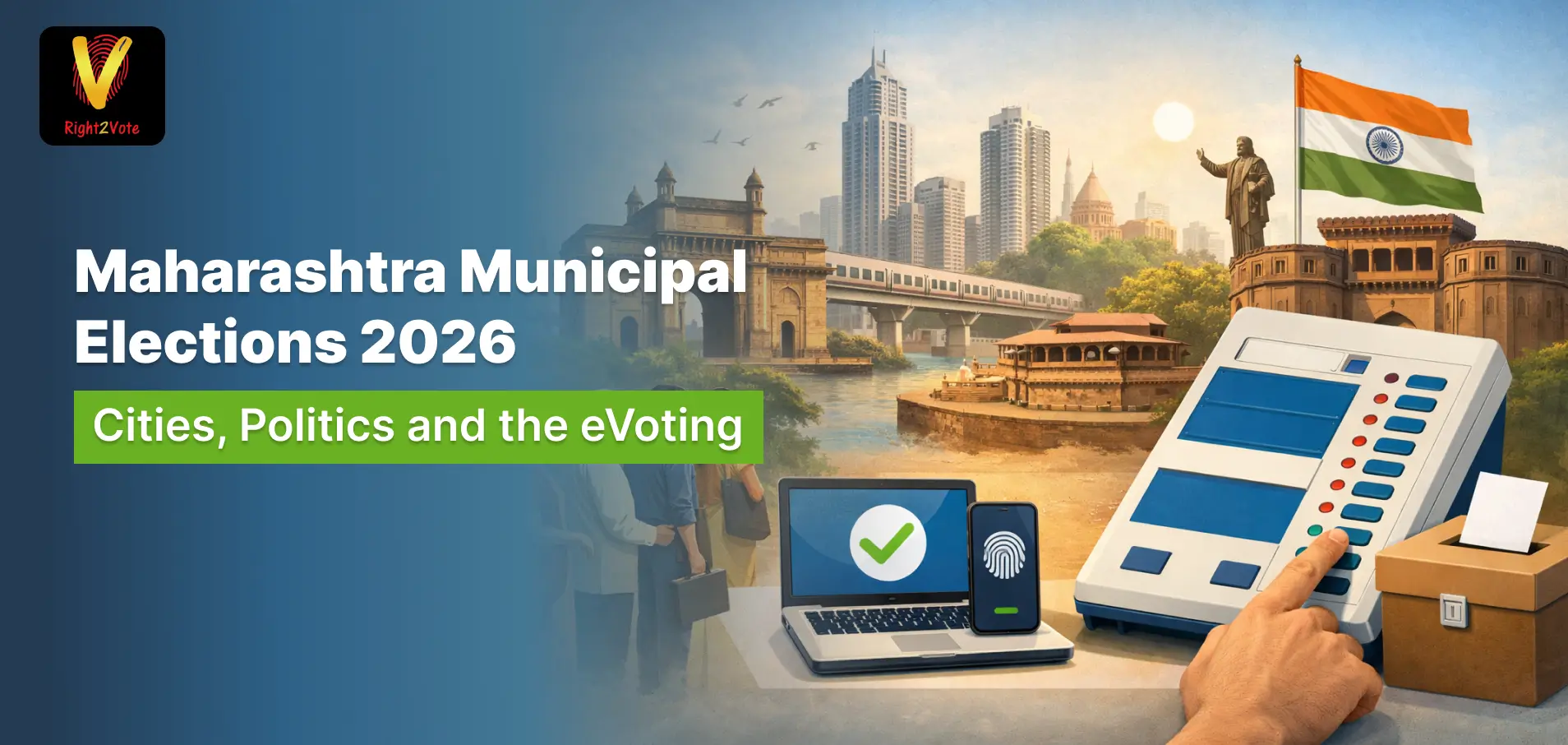
The Maharashtra Municipal Elections scheduled for 15 January 2026, with counting on 16 January 2026, are very important for the future of urban governance in the state. The government has also declared 15 January as a public holiday to encourage maximum voter participation. Municipal elections decide who will manage essential city services such as roads, water supply, sanitation, street lighting, public transport and local infrastructure development. These bodies directly affect the daily lives of citizens more than state or national governments. In Maharashtra, cities contribute a large share of the state’s economy, making these elections politically powerful. Parties treat municipal elections as a test of public mood, especially in urban areas. The results often influence leadership decisions, alliance strength and campaign strategies for upcoming Assembly and Lok Sabha elections. This is why the 2026 municipal elections are being watched closely across Maharashtra.
This blog explains why these elections are happening now, which cities and political parties are involved, where the key electoral battles are and how voting will take place. It also discusses the debate around EVMs, the absence of VVPAT, the possibility of eVoting, and how secure online voting platforms like Right2Vote can help improve participation and trust in municipal elections.
How Many Cities Are Voting and Who Are the Voters
The 2026 municipal elections will cover over 25 municipal corporations and several municipal councils across Maharashtra. Major cities included in this election are Mumbai, Thane, Navi Mumbai, Pune, Pimpri-Chinchwad, Nagpur, Nashik, Solapur, Kolhapur, Amravati and Chhatrapati Sambhajinagar. Together, these cities represent crores of voters and a large portion of Maharashtra’s urban population. These municipal bodies control large budgets and are responsible for approving development projects worth thousands of crores. Urban voters include working professionals, business owners, students, migrant workers and senior citizens. Their expectations are different from rural voters, focusing more on governance, infrastructure and service delivery. Winning control over these cities gives political parties strong organisational networks and influence at the grassroots level. This makes municipal elections a key battleground in Maharashtra’s political landscape.
Why These Municipal Elections Are Being Held Now
For the last few years, many municipal corporations in Maharashtra were run by government-appointed administrators instead of elected representatives. Elections were delayed due to court cases related to OBC reservation, ward delimitation and population data issues. These legal challenges created uncertainty and paused the democratic process at the local level. As a result, important civic decisions were taken by officials rather than public representatives, leading to dissatisfaction among citizens. Now that most of these legal hurdles have been resolved, the state government has moved forward with conducting municipal elections. Holding elections restores democratic control and allows citizens to choose leaders who are directly accountable to them. The timing is also politically important, as it helps stabilise urban governance before future state and national elections. This election marks a return to people-led city administration.
Political Parties and Alliances in the Election
The Maharashtra municipal elections are mainly contested between two major political alliances. On one side is the Mahayuti alliance, which includes the Bharatiya Janata Party, the Eknath Shinde-led Shiv Sena and the Ajit Pawar faction of the Nationalist Congress Party. On the other side is the Maha Vikas Aghadi, consisting of the Congress, the Uddhav Thackeray-led Shiv Sena (UBT) and the Sharad Pawar-led NCP faction. Although municipal elections are about local issues, party identity plays a major role in campaigning and voter decisions. Leaders from state and national levels actively campaign, turning civic polls into political showdowns. Independent candidates and local groups also contest, especially in closely fought wards, where local influence can decide results. These elections will show which alliance has stronger support in urban Maharashtra.
Cities Where the Election Battle Is Most Interesting
Some cities in Maharashtra are expected to see very close and high-profile contests. Mumbai is the most important prize, as it is India’s financial capital and a traditional stronghold of Shiv Sena politics. The battle here is especially intense between the two Shiv Sena factions and the BJP. Thane is another key city, known as a power base of the Shinde-led Shiv Sena. Pune represents educated urban voters and is a test of development-focused politics. Nagpur has long been a BJP stronghold and carries symbolic importance. Nashik and Chhatrapati Sambhajinagar are swing cities where voter preferences change quickly. Results in these cities will shape political narratives and determine who dominates Maharashtra’s urban politics in the coming years.
How Voting Will Take Place
Voting in the Maharashtra municipal elections will be conducted using Electronic Voting Machines (EVMs). Unlike the Assembly and Lok Sabha elections, VVPAT machines will not be used in these local body polls. This is permitted under existing election rules for municipal elections. EVM-based voting helps in faster polling and quicker counting of votes, reducing human errors. However, the absence of VVPAT has raised concerns among some voters and political parties regarding transparency. Election authorities have assured that strict procedures and security measures are followed to ensure free and fair elections. Polling stations will be set up across cities, and security arrangements will be in place to maintain law and order. Despite technological improvements, voter trust remains a key factor in the success of any election process.
Is Maharashtra Trying eVoting Like Bihar
Bihar recently became the second state in India to introduce mobile-based eVoting in municipal elections, allowing selected voters to cast their votes online. This experiment has attracted national attention. However, Maharashtra has not yet implemented eVoting in its municipal elections. While discussions and expert consultations have taken place, no official rollout has happened so far. The large population, political sensitivity and legal complexity of Maharashtra make authorities cautious. Any move towards eVoting requires strong laws, technical safeguards and public confidence. Still, Bihar’s experience has opened the door for future experiments in Maharashtra. Many experts believe that controlled and secure digital voting could be tested in urban local body elections in the coming years.
Problems with Traditional Municipal Elections
Municipal elections in large cities often suffer from low voter turnout. Many urban voters are busy with work, travel frequently or feel disconnected from local issues. Migrant populations find it difficult to vote due to a lack of voter registration in the new state. Senior citizens and persons with disabilities face challenges in reaching polling booths. Even when polling day is declared a public holiday, voter participation remains lower than expected. Long queues, traffic congestion and limited awareness about candidates also discourage voters. These challenges reduce the true representation of urban citizens. As cities grow larger and more complex, traditional voting methods struggle to meet the needs of modern urban voters. This has led to increasing discussions about using technology to improve accessibility and participation.
How Online Voting Can Help City Elections
Online voting can solve many problems faced in traditional municipal elections. It allows voters to cast their vote remotely, saving time and effort. This is especially helpful for working professionals, senior citizens, disabled voters and people living away from their registered address. Online voting can also encourage young voters who are comfortable using digital platforms. Faster vote counting and reduced logistical costs are added benefits. For municipal elections, where local issues matter but turnout is low, online voting can increase participation and engagement. However, convenience alone is not enough. Online voting must be secure, transparent and legally sound to gain public trust. If implemented properly, it can strengthen urban democracy and make elections more inclusive.
Importance of Secure and Trusted eVoting Systems
Security is the biggest concern when it comes to online voting. A reliable eVoting system must ensure that only eligible voters can vote, and that each voter votes only once. The secrecy of the vote must be fully protected. The system should be resistant to hacking, data leaks and manipulation. Transparency is equally important, so that political parties and voters can trust the results. Audit trails, verification mechanisms and compliance with election laws are essential. Without strong security and trust, eVoting can create doubts instead of confidence. Therefore, only tested and certified platforms should be considered for digital elections, especially in a politically important state like Maharashtra.
Why Right2Vote Is the Right eVoting Solution
Right2Vote is one of India’s most trusted eVoting platforms, with more than 10 years of experience and over 21,000 successful elections conducted across the country. The platform follows strict security standards and is STQC certified, ISO 27001 certified, and CERT-In empanelled. Right2Vote uses multiple layers of security, including OTP-based authentication and AI-based voter verification. This ensures that fake or duplicate voting is prevented. The platform is scalable and can handle large voter bases, making it suitable for urban elections in Maharashtra. Its transparent process and detailed reporting system help build trust among voters, administrators and stakeholders.
Increasing Trust and Voter Participation
Right2Vote focuses on transparency and voter confidence. It provides real-time monitoring, detailed logs and post-election audit reports. These features ensure that every vote is recorded accurately and can be verified if required. For municipal elections, Right2Vote can be used in a hybrid voting model, where physical booth voting is combined with controlled online voting for selected categories of voters. This allows gradual adoption of digital voting without replacing the existing system completely. Such an approach reduces risk while increasing participation. By making voting easier and more accessible, Right2Vote helps strengthen democratic participation at the local level.
At the request of the Maharashtra State Election Commission, Right2Vote has innovated and created an eVoting equipment for eVoting at voting booths. The eVoting machine features an integrated touch screen for voting, a fingerprint reader, a face scanner and an iris scanner for voter verification, a QR code reader for Aadhaar card verification, and a printer for voter receipt. The eVoting device is internet-enabled and ensures secure voting, Aadhaar biometric verification and instant & automatic result counting. This eVoting machine might get approval for use in future elections. Refer to this BBC video for more details.
Conclusion: A New Direction for Democracy
The Maharashtra Municipal Elections of January 2026 are a crucial moment for urban governance and political direction in the state. With important cities voting, strong political competition and high public expectations, these elections will shape Maharashtra’s future. While traditional EVM voting continues for now, discussions around online voting are growing. Secure and trusted platforms like Right2Vote show that digital voting can be safe, transparent and inclusive. As cities expand and citizens demand better governance, modern voting solutions may become necessary. Maharashtra has the opportunity to lead India’s urban democracy by adopting secure eVoting systems in the future.
To know more about Right2Vote’s election technology, please refer:
- Government of India certificates
- Features for eVoting
- Security and safety
- Pricing
- Our customers
- Contact Us
Types of elections :
Important links :
Recent Blogs :
-
 Postal Ballot System in India: How Online Voting by Mail Works
-
 The BENPOS Access Debate: Control vs Transparency in Corporate Governance E-Voting
-
 Election Process: Step-by-Step Guide to How Elections Actually Work
-
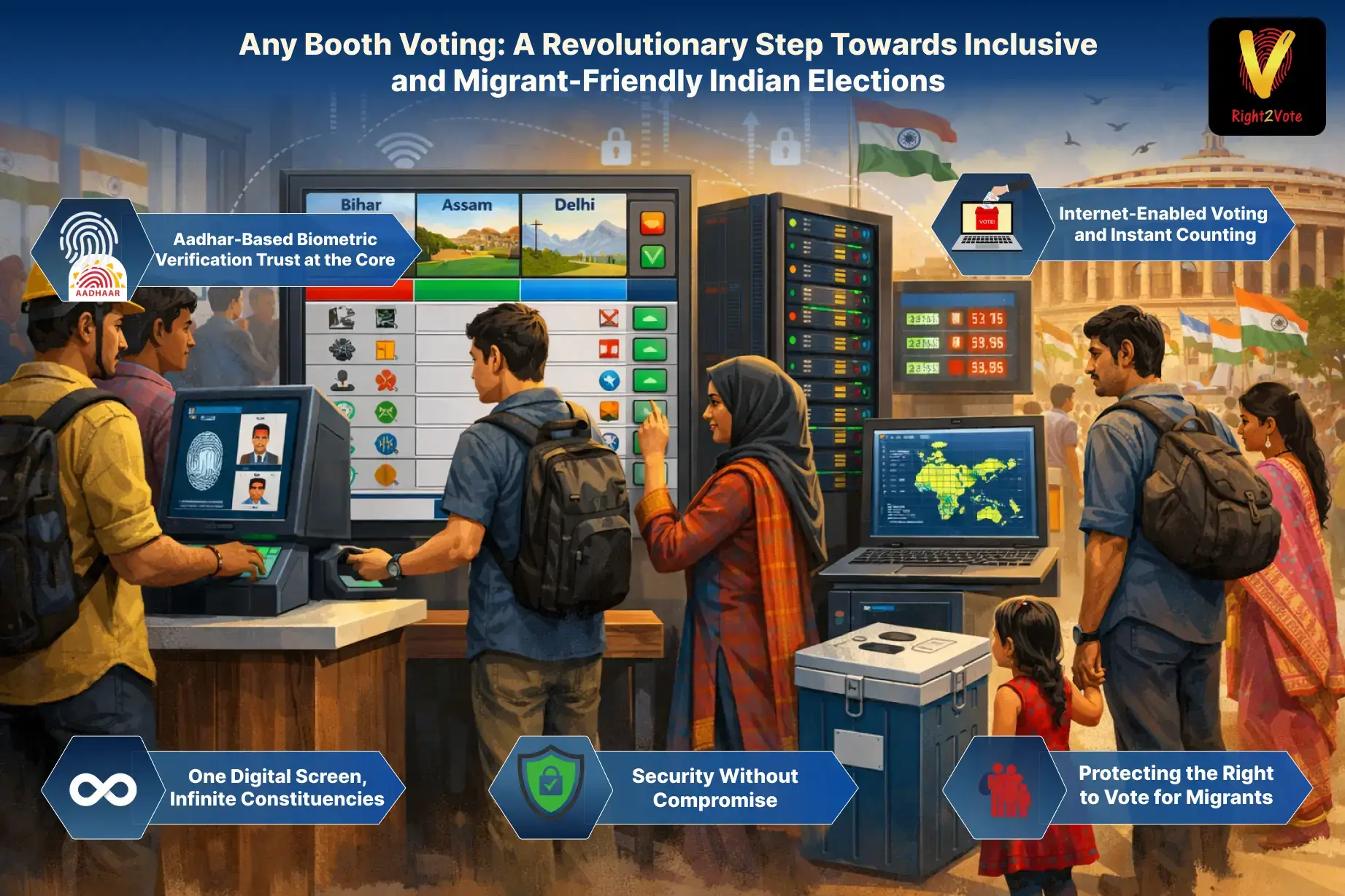 Any Booth Voting: A Revolutionary Step Towards Inclusive and Migrant-Friendly Indian Elections