Postal Ballot System in India: How Online Voting by Mail Works
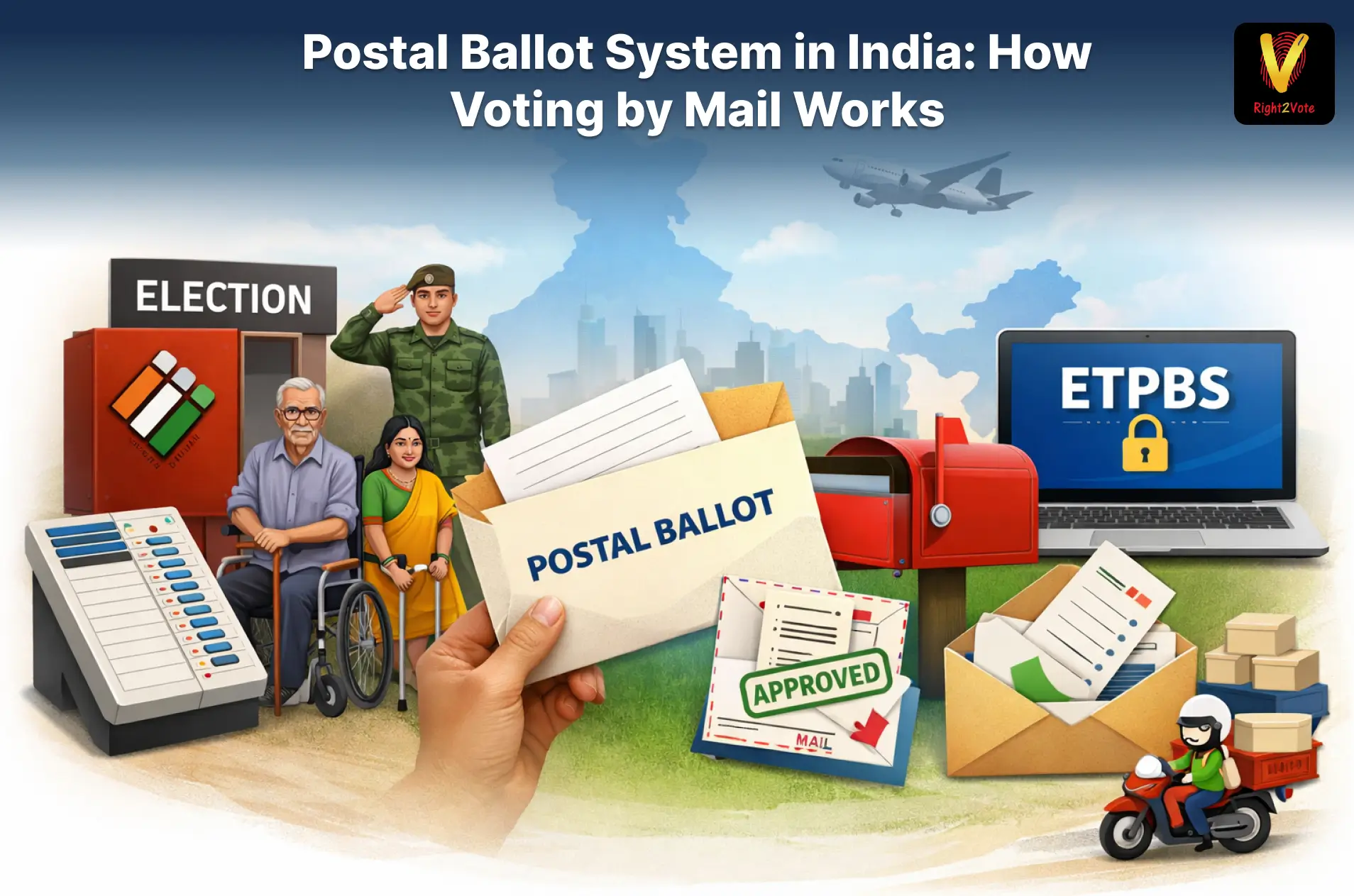
Voting is one of the most important rights in a democracy. In India, most people vote by visiting polling booths on Election Day. However, not everyone can be physically present at their polling station. To ensure that such citizens are not deprived of their right to vote, the Election Commission of India (ECI) provides the facility of postal ballots, also known as mail-in ballots.
The postal ballot system allows eligible voters to cast their vote without visiting a polling station. Instead, they can vote through a secure and regulated process by mail.
This blog explains how the Postal Ballot or Mail-in Ballot system works in India, covering eligibility criteria, the application and voting process and the Electronically Transmitted Postal Ballot System (ETPBS) for service voters. It also explores how Right2Vote enables secure, controlled remote voting within its booth-based election process.
What is a Postal or Mail-in Ballot?
The Postal Ballot system, also known as the mail-in ballot system, is a special voting facility in India that allows certain eligible voters to cast their vote without visiting a polling booth on Election Day. While most Indian voters vote through Electronic Voting Machines (EVMs) at designated polling stations, the postal ballot system ensures that individuals who cannot be physically present are still able to exercise their democratic right. This system is administered and regulated by the Election Commission of India to maintain fairness, transparency, and secrecy in the electoral process.
Why is the Postal Ballot System Important?
Under this system, only specific categories of voters are eligible to vote by post. These include service voters such as members of the Armed Forces and paramilitary forces, government officials posted outside their home constituency, polling staff deployed on election duty, persons with disabilities, senior citizens above the prescribed age limit (as notified for particular elections), and individuals under preventive detention. In recent elections, accredited media personnel and certain essential service workers have also been permitted to use postal ballots with proper authorization. The objective is to ensure that those serving the nation or facing genuine physical or professional constraints are not denied their right to vote.
It is especially useful for:
- Voters who are away from their home constituency
- Essential service providers
- Armed forces personnel
- Government staff on election duty
Without this system, many of these voters would lose their opportunity to participate in elections.
Who is Eligible for Postal Ballots in India?
Not every voter can apply for a postal ballot. It is available only to specific categories of voters:
- Service Voters: This includes members of the Armed Forces, paramilitary forces, and government officials posted outside India.
- Voters on Election Duty: Government officials, polling staff, and security personnel deployed for election work in a different polling station.
- Persons with Disabilities (PwD): Voters who cannot physically visit polling stations due to disability.
- Senior Citizens (subject to ECI guidelines): Voters above a certain age (currently 80+ in many elections) may be allowed to vote by postal ballot.
- Essential Service Workers: With special permission, media persons, healthcare staff, transport workers, and other essential duty staff may use postal ballots. Recently, the ECI allowed accredited media personnel covering elections to cast votes through postal ballots in general elections.
- Detained Persons (Preventive Detention): Individuals detained under preventive detention laws (not convicted prisoners) may be eligible.
How to Apply and Cast Vote Through Postal Ballot System
To avail of this facility, eligible voters must apply to the Returning Officer of their constituency, usually by submitting the prescribed application form, such as Form 12D. The application requires personal details, voter identification information, and a valid reason for requesting a postal ballot.
Once the Returning Officer verifies the eligibility criteria, a postal ballot is issued and sent to the voter’s registered address or through official channels in the case of service voters posted abroad.
After receiving the postal ballot package, the voter marks their preferred candidate on the ballot paper, places it inside a secrecy sleeve to maintain confidentiality and completes a declaration form confirming their identity and that the vote has been cast personally.
The sealed ballot and declaration form are then placed in a return envelope and sent back to the election authorities within the prescribed time limit. On counting day, postal ballots are scrutinized and verified before being included in the final vote tally. Invalid or improperly filled ballots are rejected according to election rules.
Electronically Transmitted Postal Ballot System
The Electronically Transmitted Postal Ballot System (ETPBS) is a technology-driven initiative introduced by the Election Commission of India to facilitate faster and more efficient voting for service voters. Instead of sending the ballot paper only through traditional postal channels, the ballot is transmitted electronically to eligible service voters. However, after marking their vote, the voter must return the completed ballot physically by post. This combination of electronic transmission and physical return helps reduce delays while preserving the secrecy, authenticity, and legal validity of the voting process.
The system operates through structured stages that ensure security and administrative control at every level. Service voters must first register themselves using prescribed forms depending on their category. Once registered and approved, their names are added to the service voter electoral roll. After the announcement of elections, authorized officials activate the system, generate constituency-specific ballot papers, and securely transmit password-protected ballots to service voters through designated record offices or unit commanders.
The service voter then downloads the ballot in PDF format, prints it, marks their preferred candidate, signs the required declaration, and seals the ballot in the prescribed envelopes. The completed ballot is sent by post to the Returning Officer. Upon receipt, officials verify the ballot, including scanning the QR code and checking the declaration form, before accepting it for counting. Valid ballots are included in the final tally along with other postal ballots.
Key features of ETPBS:
- Electronic transmission of ballot papers to service voters
- Physical return of marked ballots by post
- Use of password-protected PDF ballots
- Secure delivery through record offices or unit commanders
- Mandatory declaration form and sealed envelope process
- Verification
- Inclusion of valid ballots in the official counting
Through this system, technology is used to improve speed and efficiency while maintaining strict procedural safeguards, ensuring that service voters can participate in elections even when posted far from their home constituency.
While government elections follow statutory postal ballot procedures, digital election platforms like Right2Vote have developed structured remote voting mechanisms for private and organisational elections.
How Right2Vote’s Postal/ Mail in Ballot System Works
Right2Vote’s Postal Ballot / Mail-in Ballot works as an extension of the Right2Vote Booth-Based Voting System. It is designed for voters who are unable to physically reach the designated polling booth on election day. While booth-based voting remains the primary mode, this facility ensures that no eligible voter is left out due to travel, health, work commitments or unavoidable circumstances.
In the standard booth-based system, a unique booth code is provided at the polling location, and voters must be physically present to use that code and cast their vote. However, if a voter is unable to attend the booth, they must inform the election team in advance. The voter needs to clearly specify that they will not be able to reach the polling booth and request permission to vote remotely.
Once the request is submitted, the election team reviews the application. If approved, the voter’s credentials are added separately to a specially approved remote voter list. This step ensures that only verified and authorized voters are allowed to use the postal or mail-in voting facility within the system.
On voting day, the approved remote voters can log in to the Right2Vote platform using their registered email ID or mobile number. After logging in and clicking the “Vote” button, a verification box appears on the screen asking for a unique code. This code is not publicly available. It is securely sent only to approved remote voters by the election team on the day of voting.
After entering the received code and confirming their details, the voter is granted access to cast their vote securely. This ensures that:
- Only pre-approved voters can vote remotely
- The voting process remains secure and controlled
- Unauthorized access is prevented
- Booth-based voting integrity is maintained
- Remote voting is enabled only in genuine cases
Key Conditions of Right2Vote Postal / Mail-in Voting:
- The voter must inform in advance that they cannot reach the booth
- The election team must review and approve the request
- The voter is registered as a remote voter
- A unique voting code is sent only on voting day
- Voting is allowed only after code verification
Through this controlled process, Right2Vote ensures that remote participation is possible without compromising election security, transparency, or fairness. It combines the discipline of booth-based voting with the flexibility of remote access, making the system inclusive while maintaining strong verification safeguards.
Why Right2Vote Postal Voting Is Better Than Traditional Postal Ballots
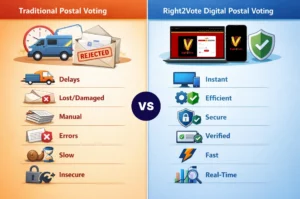
The traditional postal ballot system has several operational and practical limitations. Since it depends heavily on physical dispatch and return of ballot papers through postal services, delays are common. Ballot papers may reach late, be lost in transit or fail to return before the counting deadline. This can result in genuine votes being excluded from the final tally.
Another major concern is the lengthy manual process. From application approval to ballot printing, dispatch, marking, sealing and verification, every stage involves physical documentation and handling. This increases administrative workload and the possibility of human error. Improperly filled forms, missing signatures, or incorrect sealing of envelopes often lead to rejection of ballots.
Security and secrecy concerns also exist. While procedures are designed to protect confidentiality, physical ballots can be tampered with, damaged, or exposed during transit. Additionally, verifying signatures and declarations manually can be time-consuming and sometimes inconsistent.
Key flaws in traditional postal voting:
- Heavy dependence on postal delivery timelines
- Risk of delay, loss, or damage in transit
- High administrative burden
- Manual verification process
- Ballot rejection due to minor procedural errors
- Slower counting and result integration
- Limited real-time tracking or monitoring
The Right2Vote Postal Voting System is designed as a controlled digital extension of booth-based voting. Instead of relying on physical ballot transmission, it uses a secure login system with pre-approval and unique code verification. This significantly reduces delays because there is no physical dispatch of ballot papers.
In this system, voters must request remote voting in advance. The election team reviews and approves only genuine cases. Approved voters are registered separately, and a unique voting code is sent only on voting day. This ensures controlled access and eliminates dependency on courier or postal networks.
Since voting happens within a secure digital environment, there is no risk of ballot paper damage, envelope errors, or postal rejection. Verification happens instantly through registered email/mobile login and code authentication. Administrative workload is reduced, and results can be integrated seamlessly into the overall counting process.
Advantages of Right2Vote Postal Voting over traditional postal voting:
- No dependency on postal delivery
- Instant digital access on voting day
- Reduced administrative handling
- Secure login-based authentication
- Unique code-based voter verification
- Lower risk of procedural rejection
- Faster integration into the final results
- Real-time monitoring and control
Conclusion
Postal voting plays a crucial role in ensuring inclusive participation in elections. In India, the traditional postal ballot system ensures that service voters, senior citizens, and essential personnel are not excluded from the democratic process. However, it comes with operational challenges due to physical handling and time constraints.
Right2Vote’s Postal / Mail-in Voting system modernises this concept for organisational and institutional elections. By combining booth-based discipline with secure digital authentication, it removes logistical delays while maintaining strict verification safeguards.
In essence, traditional postal ballots serve statutory public elections, while Right2Vote’s structured remote voting system offers a faster, controlled, and technology-driven alternative for private and managed elections.
 West Bengal Election 2026: More Than an Election, A Turning Point for Bengal
 The BENPOS Access Debate: Control vs Transparency in Corporate Governance E-Voting
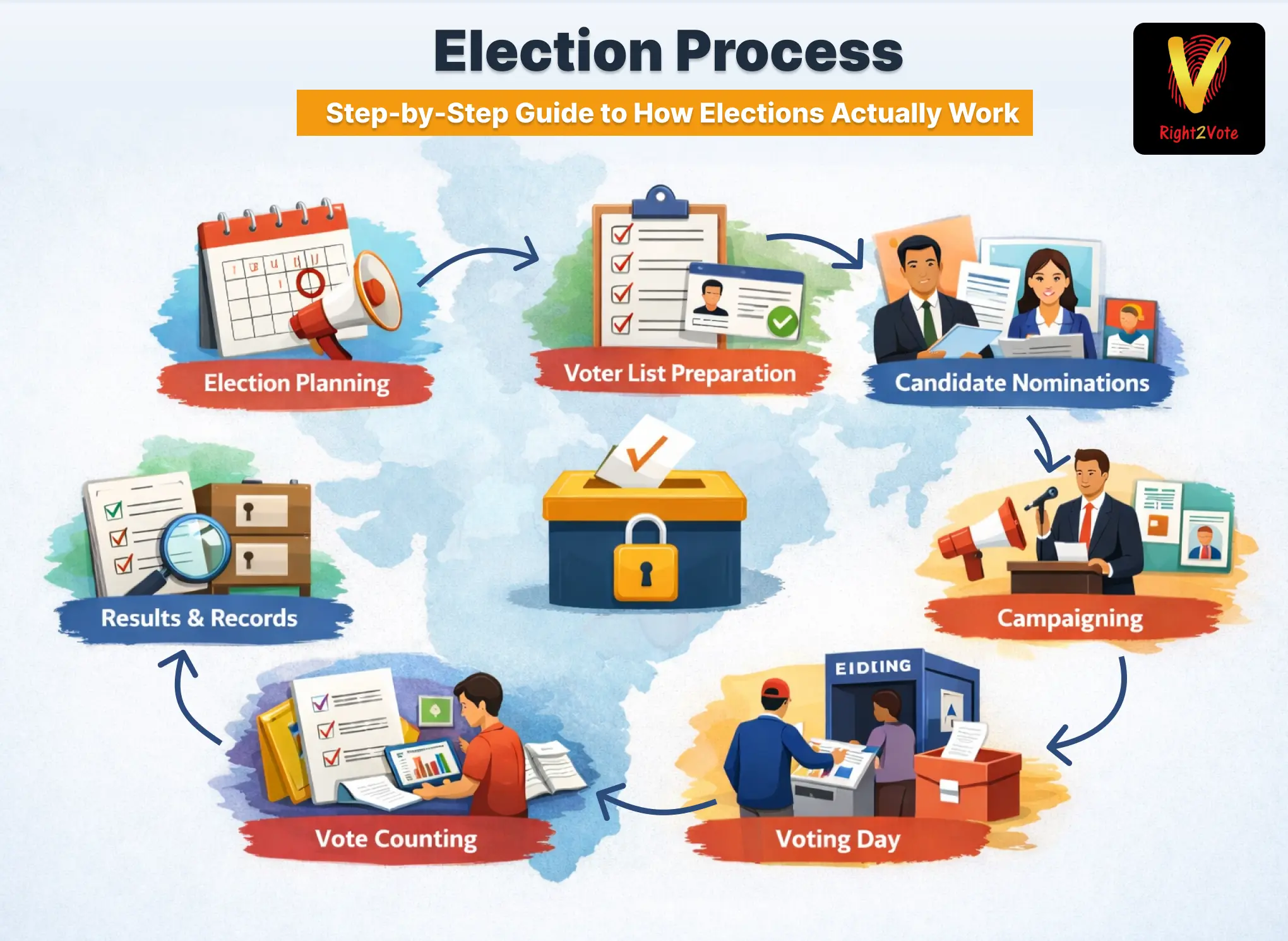 Election Process: Step-by-Step Guide to How Elections Actually Work